
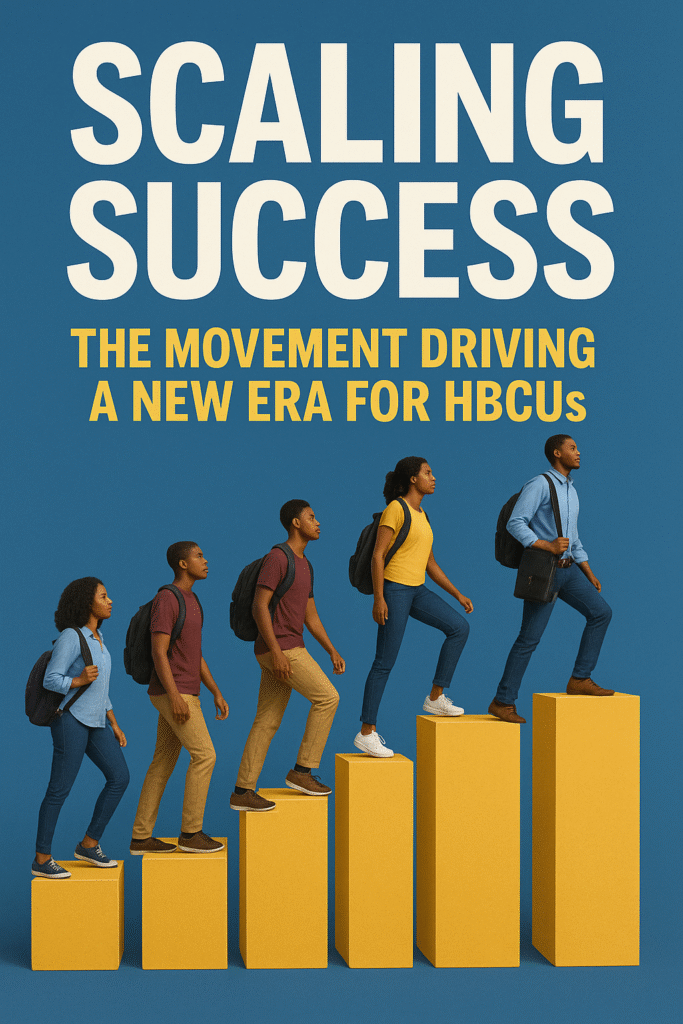

A large-scale initiative is quietly reshaping the future of historically Black colleges and universities (HBCUs). Through the HBCU Transformation Project, 40 institutions—public, private, rural, and urban—are working together to improve enrollment, graduation rates, and student success, while building models that could influence the rest of higher education.
The project, launched in 2021 and led by the Thurgood Marshall College Fund (TMCF), United Negro College Fund (UNCF), and Partnership for Education Advancement, is grounded in the idea that collaboration can achieve more than competition. Rather than working in isolation, participating schools are sharing systems, strategies, and lessons learned—creating what organizers call a “networked approach” to institutional improvement.
The goals are ambitious: a 40% increase in enrollment at HBCUs, a 54% increase in graduates, and $1.1 billion added to Black net worth annually. That vision has drawn significant support from the philanthropic community. Blue Meridian Partners, a New York-based funder focused on scalable solutions to social challenges, invested $60 million to help launch the initiative and committed an additional $124 million in 2023 based on early progress.
“This very significantly scaled grant from them signals to the philanthropic community that this is a really good investment to make,” said Michael Lomax, president and CEO of UNCF, in an interview with the Associated Press.
Some of the early results are promising. South Carolina State University used part of the first round of funding to modernize its enrollment and financial aid systems, replacing a patchwork of disconnected tools with a unified platform that improved communication with prospective students. As a result, first-year enrollment climbed from 371 students in 2019 to 1,200 in 2023.
A recent study found that in 2019 alone, eight Ivy League universities received $5.5 billion from top U.S. foundations, while 99 HBCUs received just $45 million. Between 2002 and 2019, foundation support for HBCUs declined 30%—even before adjusting for inflation.
Other institutions are adopting tools like InsideTrack’s student coaching services, which provide one-on-one support to students and staff, and Mainstay’s AI-powered chatbot, which helps campuses engage students through real-time text and web communication. A shared customer relationship management (CRM) platform—referred to as HBCU Dx—is streamlining administrative workflows and freeing up staff to focus on student-facing work.
The collaborative approach is particularly important in a sector that has long faced structural barriers. A recent study found that in 2019 alone, eight Ivy League universities received $5.5 billion from top U.S. foundations, while 99 HBCUs received just $45 million. Between 2002 and 2019, foundation support for HBCUs declined 30%—even before adjusting for inflation.
“It’s long overdue,” Rutgers professor Marybeth Gasman, an expert on HBCUs, told the Associated Press. “Sharing services is a great idea for financially under-resourced institutions—frankly most colleges and universities benefit from sharing services.”
While progress has been strong, the HBCU Transformation Project is still in its early stages. Participating schools must meet benchmarks around enrollment, graduation, and post-graduation employment to sustain funding.
Still, leaders are embracing the challenge. Blue Meridian’s Jim Shelton said the organization would rather see schools “set ambitious goals and miss them” than aim too low.
As the project expands and more funders join, organizers hope the model will not only transform the 102 HBCUs nationwide but also demonstrate what’s possible when institutions work together to meet the needs of today’s students.