
Last Updated on July 30, 2025 by BVN
Alyssah Hall
Launched in 2015 as a project dedicated to empowering the greater Black Californian population by leveraging data that helps identify systemically induced racism and inequities, Mapping Black California (MBC) is celebrating its tenth anniversary this year.
Founded by second-generation publisher of Black Voice News and founder of Voice Media Ventures Paulette Brown-Hinds, MBC seeks to provide reliable data and contribute to social and economic change.

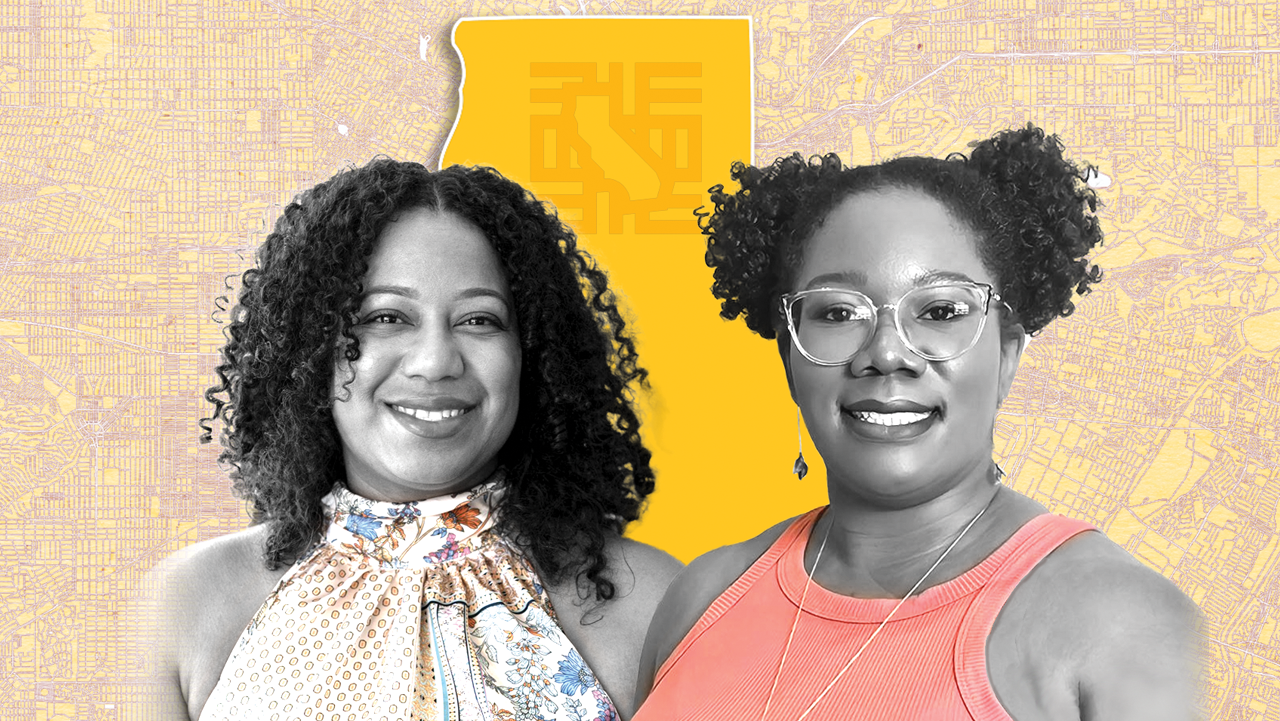
Over the last six years, the small, but mighty team at MBC has been composed of Project Director Candice Mays and Project Manager Alex Reed. Since Mays joined in 2019 and Reed in 2020, the team has undertaken several data projects and developed detailed maps for partners.
In 2020, the organization launched the MBC Census Lab with 400 community-based organizations and 32 media partners that collectively worked on census reporting and community engagement with the hope of getting a complete count.
Part of this effort included a hard-to-count map built by the MBC team to more effectively target Black populations in California that were identified as difficult to count. The campaign utilized messaging that would inform them about the census and encourage them to participate.

In her role, Mays considers herself a transdisciplinary storyteller, examining the intersections of commonality and not competing factors. She seeks out what is happening in the community, what coalitions are forming, what people need and want.
According to Reed, the work MBC does touches her heart because it holds the powers that be, not only accountable through data, it also equips Black communities with quantitative data and encourages equity.
As the project manager, Reed aims to remove barriers to entry by translating data so that everyone can understand, especially Black communities who are often under-resourced.


“We’re biased towards bettering the outcomes of Black people, but towards that bias, we want to be as transparent as possible, and we want to be as accurate as possible,” said Reed. “I think the real importance of my role was expressed in making sure that everything that we put out into the world is really unfudgeable. You can’t argue with it, and what it has to say.”
One MBC project that Reed recalls as being impactful is their Racism as a Public Health Crisis Dashboard. Their interactive map is an accountability tool that allows individuals to view any cities, counties or other governing organizations that have established racism as a public health crisis. This project was partnered with a BVN written series as well as the Starling Lab for Data Integrity, a research lab anchored at Stanford University’s School of Engineering and the University of Southern California’s Shoah Foundation.
“That project started by archiving the declarations that were coming in. We started collecting the data for it in February or March of ‘21 because that’s when we really saw the first real, tangible conversations about getting declarations on the books,” Reed said.
The first big rush of declarations came out in June of 2021, which is when the platform for Racism as a Public Health Crisis was getting built. The action of declaring racism as a public health crisis was entirely inspired by George Floyd’s Murder in May of 2020.
2019 Esri User Conference
Jack Dangermond presents the “Making a Difference” Award to the Mapping Black California and Ignite Leadership Academy at the 2019 Esri User Conference in San Diego: Jack, Paulette, Candice Mays, Alex Reed, Breanna Reeves, and Shirley Coates

Reed believes the dashboard has the potential to grow into a hub and really be of service to communities.
“There was so much action around that. [W]hole communities were really inspired to put pressure on their leaders based around the inciting incidents with [the] George Floyd murder. Then, we saw real, tangible things happen,” Reed explained.
“I feel [like] between the new technologies that we’re experimenting with and the new platforms that we’re using, that project, to me, is just so exciting, being a gathering space for people,” she continued.
While the work of MBC is focused on accountability, it is also driven by solutions, and using data, technology and storytelling to map out those solutions.
According to Mays, Geographic Information Systems (GIS) often showcases data used in mapping as numerical and statistically based. However, Mays is also interested in mapping as a storytelling tool, and finds that the data looks different in the Black community through oral histories, primary resources and artifacts that also qualify as data. This allows MBC to authentically communicate the story of Black people and their experiences through these items that qualify as data.
“I’m always looking at the different threads and how they intersect and or can be braided together to create a solution,” Mays explained.
Mays described herself as the mediator in her role as she works with stakeholders who are working to figure out how to address community needs. Mays helps multiple stakeholders understand how their interests can be woven together to create a multi-solving or initiative tactic.


“In order for the data you’re telling about one community to have the highest level of veracity, you have to be telling the story of other communities in tandem. And so in telling the Black story, you are also telling the story of these other communities,” she explained.
As an interdisciplinary storyteller, one of Mays’ favorite MBC projects is The Blackest City in the Inland Empire. Growing up in Moreno Valley, Mays always loved her home town and was aware of the value of her community and the history behind it that not everyone knew about.
“It was the one opportunity where everything I loved about being from this place and about storytelling combined. It was an opportunity to exercise all of my theories about transdisciplinary storytelling at once,” Mays said. “I leveraged oral histories of community members as data.”
Mays asked professor of anthropology at UCR, Dr. Anthony Jerry, to assist her in conducting oral histories because she had never done them before. They recorded oral histories of eight Moreno Valley residents and asked them questions like how they got to Moreno Valley, how they became established, and then where they are now.
Future of MBC
“I see the work of Mapping Black California as continuing to experiment with new technologies like the work we are currently leading with Web3, blockchain, and Generative AI to help better tell our stories for future generations,” Brown-Hinds said.
“We will continue to build on the first ten years and hopefully expand beyond California,” she shared.
Both Reed and Mays expressed gratitude toward Brown-Hinds, both for her vision and the freedom she entrusts them with.
“In the future, I’m really hoping that we can just do more to make it more available and make it more interactive, and give other people the same ability to play that we were given just because so much was already done for us when we got here,” Reed shared.

As MBC continues leveraging data and storytelling to help Black communities forge solutions, the team wants the public to know the importance of their own stories and utilizing MBC as a resource.
“Mapping Black California’s goal is to tell those stories and to amplify those stories and disseminate those stories through data and map making. The focus is not about our work,” Mays said. “The focus is about them and how we can make their lives better and how we can contribute to the preservation of our people and the people they know and the things they care about and love.”
The public can look for brand new updates and indicators on BEIDataReport.com and StopTheHate Dashboards this coming Fall. MBC is working on wildfire and political preparedness collaborations with BVN as well as ways to get involved in community action with MBC and San Bernardino’s Human Rights Coalition.

“We have been able to carve out a space and build a platform that we are not trying to keep to ourselves, and we’re not even necessarily trying to be the people at the top of the podium, we want everyone standing next to us,” Reed said.
“I see Mapping Black California doing way more than mapping because it’s about our ability to deliver data to people in digestible ways and transferable ways. I want to see mapping by California do that in all the ways that is possible, with mapping included, but also beyond mapping,” Mays said.