
For the second consecutive year, Liberian officials visited the D.C. metropolitan area to engage its scattered children in conversation about their part in Liberia’s future development.
Among those involved in the planning of the annual conference, which has since come and gone, was an entrepreneur and Liberian repatriate who remains skeptical about the Liberian government’s posture toward diasporans returning home.
“They made qualified people not feel comfortable. Even their own sons and daughters who were given the opportunity to study abroad and come back home … feel out of place,” George Gablah Brownell Jr. told The Informer. “It’s not a bad thing for somebody to push you to do better [but] our people have a problem playing the backseat. It’s so hard for our people to say they don’t know, and the nation itself needs to come to that realization.”
Brownell served on the committee that organized the 2026 Liberia Diaspora Annual Conference, part of which took place at Hilton Alexandria Mark Center Hotel in Alexandria, Virginia on Sept. 25-27. For three days, Liberians brought to life the theme of “From Dialogue to Delivery: Diaspora Capital, Innovation and the Next Liberia” as they discussed how to organize and actualize long-term diasporic investment in health care, agriculture, art, technology, education, and infrastructure.

By the time Brownell, a Liberian born and raised in the U.S., took on a leadership role in diaspora conference planning, he already had under his belt five years as a resident and businessman in his ancestral homeland. Since making his move to Liberia during the pandemic, Brown has transformed the several acres of land he purchased into rental property and a farm that yields the country rice he exports.
Brownell has also experienced what he described as “bottlenecks,” including an annual business registration fee that he said dampens the pursuit of an entrepreneurial venture in Liberia. As he recounted to The Informer, Brownell has also fallen victim to Liberian government employees who he said, in the absence of systems and accountability measures, delay processes to extract bribes.
“Government is a reflection of the people, [and] when we’re moving into this environment as outsiders, we have to remember how there’s somebody behind us that’s aspiring to be a part of the dysfunction,” Brownell said. “People are extremely selfish, and it might be an effect of poverty. At the same time, you have to ask yourself if it’s because people are poor or they just don’t want to do the right thing.”
Liberian President Joseph Nyuma Boakai Sr. Speaks to the People
Last year, the inaugural diaspora conference, themed “Building the Future Together: Reconciliation, National Healing, Growth and Prosperity,” focused on resolution of deep-seated conflicts, along with healthcare, education, investment and trade.
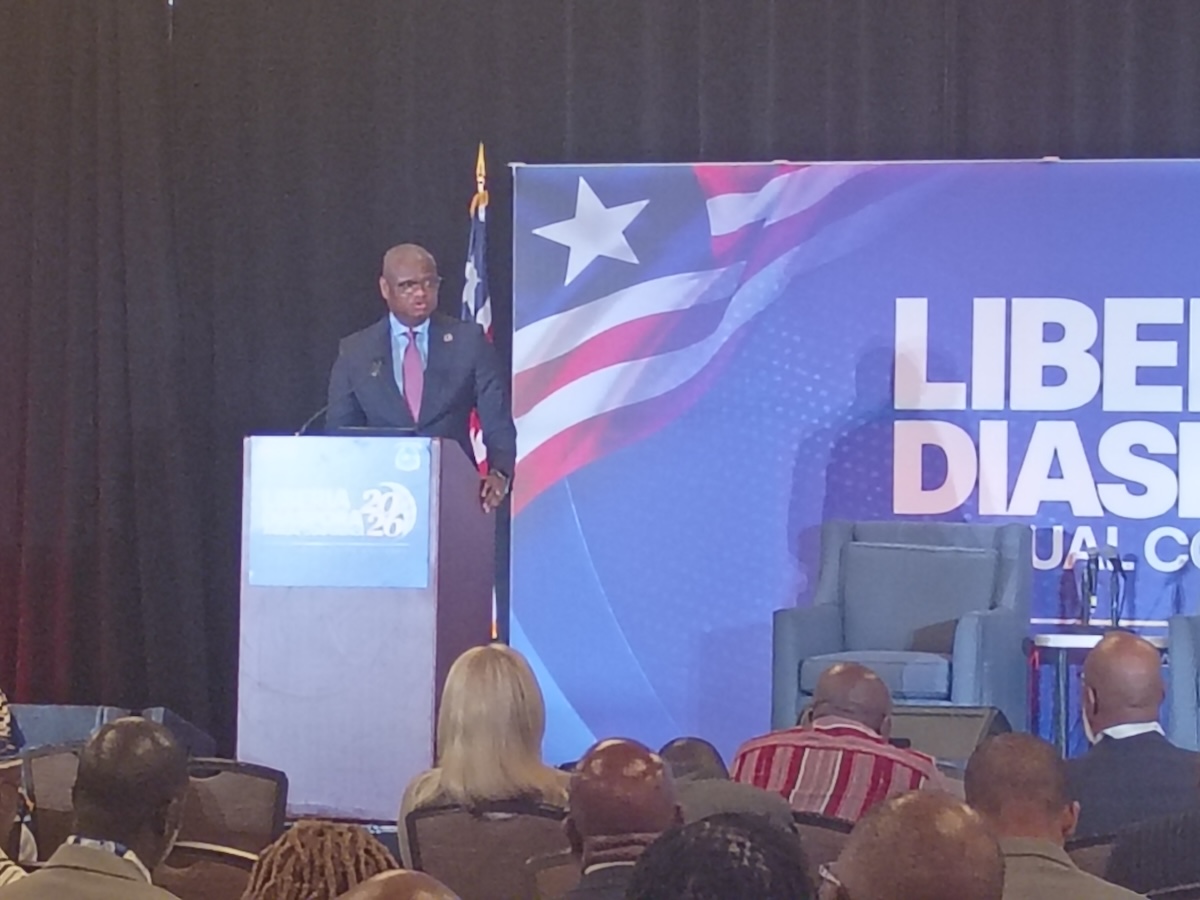
Liberian President Joseph Nyuma Boakai Sr. has since pledged to foster healing in the West African nation bouncing back from civil wars and an Ebola epidemic. Well before he approached the podium in the ballroom of the Hilton Alexandria Mark Center Hotel on the evening of Sept. 26, the collective of legislators, ambassadors, and cabinet members who accompanied him to this year’s diaspora conference had already touted incremental technological advancements, an increasingly consistent energy grid, stronger intergovernmental cooperation, and electoral reform.

Speakers also touched on efforts to expand voting rights and other privileges to Liberians living around the world. In his remarks, Boakai would later characterize such developments as an attempt to return the favor diasporan Liberians had long extended to their Motherland.
“The objective is not to ask you to give more,” Boakai said. “It’s to create a credible system to allow you to contribute more effectively and with confidence. The diaspora has already demonstrated what this partnership can accomplish… You are carrying expertise and resources to communities across the country and we are very grateful for these efforts.”
Since entering office in 2024, Boakai has set out to actualize his ARREST (Agriculture, Roads, Rule of Law, Education, Sanitation, and Tourism) agenda. He voluntarily reduced his salary by 40% while suspending more than 450 government officials for alleged corruption. He’s also ordered audits of the Central Bank of Liberia and other institutions.
Amid what’s been designated a national drug crisis, the Boakai administration has fired top drug enforcement officials and launched a multi-sector task force to tackle this public health matter. Other priorities center on reducing reliance on imported rice, constructing and rehabilitating several kilometers of roads, and expanding the nation’s electricity network.
Even with that, Boakai said there’s more work to be done.
“The true value of achievement will…be measured by better roads, better schools, health services, jobs, opportunities and improved livelihood,” he told audience members on Sept. 26. “We must match revenue with accountability, investment with integrity, and policy with implementation. Diaspora engagement cannot be sustained by appeals to patriotism alone. Government must help make returning home [and] investing practical, predictable and worthwhile.”
Liberian Youth Make Their Mark
The 2026 Liberia Diaspora Annual Conference kicked off on Sept. 25 with networking and an open plenary session that featured D.C. Metropolitan Area Liberian Community Association President Sebastian Teclar, Jackie McKay of Liberia’s Ministry of Foreign Affairs, MacDella M. Cooper of the Movement for One Liberia, and Erasmus T. Williams of Liberia’s Office of Diaspora Affairs.
The conference concluded on Sept. 27 with a presidential town hall at the Harvest InterContinental Church in Olney, Maryland, that placed Boakai before hundreds of Liberians.
Other speakers who graced the stage at the Hilton Alexandria Mark Center Hotel throughout the weekend included: Ambassador Emmett L. Dunn, chair of the national planning committee for the 2026 Liberia Diaspora Annual Conference; Liberian Ambassador to the U.S. Al-Hassan Conteh; and Christine N. Umutoni, who serves as United Nations resident coordinator in Liberia.

For Umutoni, Liberia’s future lies in the hands of its children.
“The youth must [be] used as partners. Not only as beneficiaries,” Umutoni said on Sept. 26. “That means connecting young people in Liberia with young Liberians and people of Liberian heritage through mentorship, entrepreneurship, innovation and exchange. For the second and third generation born and raised in the diaspora, the connection with their heritage cannot be taken for granted. It must be intentional.”
Rolyn M. Clarke, a family nurse practitioner, said she and hundreds of other young Liberians whom she’s organized under her nonprofit are prepared to help the Liberian government in whichever way possible.
“The government is going to be the government [and] they’re going to have friction points [but] how you work yourself kind of within those challenges goes a long way,” Clarke told The Informer. “When we look at certain policies and structures that are placed in different countries or different states that worked well, they may not work well for Liberia. Where we can find alignment is we can say, ‘Hey, there’s a group of young professionals that you can mobilize.’”
As the executive director of Heritage X Hustle, Clarke has spent the past seven years coordinating networking events for young Liberian professionals. At this juncture, she and her colleagues have set out to develop a registry that would give some indication of the skills sets and social capital that the Liberian government can leverage.

While that work gets underway, Heritage X Hustle continues to curate intimate, but intentional gatherings. During the conference, organizers commandeered a room nestled in the corner of the Hilton Alexandria Mark Center Hotel’s bottom floor. That’s where Heritage X Hustle hosted Liberians between the ages of 21 and 45 with libations, food, and networking opportunities.
“We really wanted a place where young professionals can kind of get away and connect and actually exchange ideas,” Clarke said. “They’re absorbing a lot of information at this conference, meeting a lot of people, and we really need to mobilize amongst each other, figure out what problems we can solve in our community, and then we network together to figure out how to make that happen.”
In the mid-1990s, Clarke immigrated to the U.S. to escape the Liberian Civil War. She told The Informer that she and other Liberians who’ve acquired their education in the diaspora are looking with glee toward their native land. She noted, however, that it’s also about recognizing that young Liberians back home have just as much to contribute, if not more, to the cause.
“Young professionals are the majority of our population, [and] the older people are phasing out,” Clarke told The Informer. “If we have the knowledge, we should also kind of come together so we can speak in one voice and really make an impact. That means sharing ideas, exchanging information, exchanging resources on capital growth.”
In December, Liberians around the world will return to Liberia to see family and take part in holiday festivities. A diaspora annual return committee recently revealed its intentions to take this occasion, known as Decrembree, to the next level with a calendar of events intended to showcase landmarks and business opportunities back home.
Liberian-born entrepreneur John Greaves said he plans to, once again, set foot on the land of his birth.
“We want to figure out how to showcase Liberia in a beautiful way that will attract people to open up the tourism sector,” Greaves told The Informer. “Hopefully, a lot of the projects that people are working on are well-developed and are something…that we will be able to show to the world.”

Greaves, known to many as JBizz, immigrated to the U.S. as a youth in 2000, and has since lived in Salisbury, North Carolina, Atlanta, Trenton, New Jersey, and now Philadelphia. These days, he oversees a handful of ventures, including his restaurant Food Geez, an entertainment management company named Connect the Dots, and a popular weekly podcast named In the Fries.
Along the way, Greaves, as he recounted to The Informer, has learned about the importance of systems. As Liberia bounces back from a checkered past, Greaves has expressed a desire to create an infrastructure in his home country that will allow more Liberian artists to blow up on the world stage, much like their counterparts in Ghana, Nigeria, and South Africa.
“If everybody’s doing their own thing, nothing makes sense,” Greaves said. “There’s no collective effort of people coming together to build things. I’ve been in a lot of different sectors when it comes to entertainment. I understood that Liberia’s lack of a system in the music industry is why our industry is not thriving.”
During the Liberia Diaspora Annual Conference, Greaves spoke about his vision, touching on years of experience on both sides of the Atlantic Ocean that have placed him among the likes of various Liberian artists, including those who are connected to Nicki Minaj and Chris Brown.
While he acknowledged trust, or lack thereof, as a major hurdle in accomplishing his goal, Greaves said that Liberians in the diaspora have to lead by example to spark hope.
“We’ve got to just show them,” Greaves told The Informer. “If somebody trusts you, they’ve got to see you doing something. You can’t keep telling them, ‘Oh my man, they see how we’re working here.’ They’re not out here. And where they’re at, the systems don’t work.”
Creating Systems, Building Confidence, and Obeying Obligations to Family
As Liberian historian C. Patrick Burrowes explained, Liberia has great potential depending on its government and diaspora’s ability to work together. Weeks before attending the 2026 Liberia Diaspora Annual Conference, he spoke before an audience of Liberians in Silver Spring, Maryland, about how a change in the collective mindset can bring about a resurgence in Liberia’s global standing.

“Being aware of the many breakthroughs and important accomplishments that the Liberian people have undertaken over centuries, I just felt an obligation to share what I know,” Burrowes told The Informer. “It’s especially important to share the inspirational aspects, because a lot of Liberians have gotten into a mindset of negativity based on the war experience. I’m not saying our story is just pretty and all good and light, but it’s not all negative, and that’s what generally is being disseminated”
Burrowes — whose catalog of written works includes: “Between the Kola Forest and the Salty Sea: A History of the Liberian People Before 1800”; “Liberia & the Quest for Freedom (The Half That’s Never Been Told)”; and “Citizenship & Nationality in Liberia (The Half That Has Never Been Told)” — developed the journalism curriculum at the University of Liberia in the 1980s after decades in the U.S. as a student at Howard University and Syracuse University.
During the Liberian Civil War, Burrowes returned to the U.S. to pursue his doctoral education at Temple University. He later returned to Liberia to serve as an administrator at Cuttington University. Through it all, he’s counted among one of the most prominent voices in Liberian history, culture and diasporic engagement.
Such accumulation of knowledge, he said, has inspired some thoughts about what the Liberian government can do to encourage diasporic repatriation.
“If the government is able to play its cards right and entice some of those folks to return, you’re looking at improving health care and education,” Burrowes told The Informer. “There are Liberian parents who won’t go back permanently…unless schools are on par with the schools elsewhere, and medical care is improved.”
In the same breath, Burrowes said it’s not all on the government. In citing what he called a misunderstanding that Liberians at home have about life in the U.S. and other more developed nations, Burrowes told The Informer that diasporans can take incremental steps in building trust with those still living in Liberia.
“If folks in the diaspora were to adopt a hospital or a particular school and say, ‘We are going to do everything we can to have these institutions revitalized and put on a footing where they will represent our engagement,’” Burrowes said, “it shows that we want folks to have the best.”

The recent diaspora conference attracted Dr. Nicole Cooper, one of the untold number of Liberians who’ve made their way back home to develop the health care infrastructure. Though she’s found her stride in doing so, Cooper told The Informer that the Liberian government could make it easier.
“Taxation for a health care business should not be the same as taxation for a salon or a luxury boutique,” said Cooper, CEO and medical director of Wellness Partners Medical Center. “If the health sector is a priority and you need it to be able to grow disproportionately faster, you need to make it easier for health care businesses to grow because at the end of the day, they’re collaborating and lifting the weight off the government’s public health sector.”
During the Liberia Diaspora Annual Conference, Cooper presented the Wellness Partners Medical Center as a suitable option for Liberians abroad seeking consistent medical care for their loved ones back home. A practicing medical professional of 15 years, Cooper launched Wellness Partners Medical Center after permanently moving back to Liberia in 2017.
More than five years after its inception, Wellness Partners Medical Center is still in Monrovia, the capital of Liberia.
“We create membership plans and health savings accounts your family member can be on so they have the convenience of seeking care when they need it, instead of waiting until they feel comfortable reaching out to ask for money,” Cooper told The Informer. “Our goal is to deliver safe, reliable, and convenient care. We like to say that we deliver global standards with Liberian excellence.”
Cooper spent her formative years in Ghana before graduating high school and moving to the U.S. to complete her undergraduate, graduate, and medical school education, along with residency. When returning home, what started as an exploration of opportunities turned into a calling, she told The Informer.
For Cooper, the most significant part of the experience is creating a service that works on its own, regardless of whether she’s on site.
“There are people that know me personally that don’t even call me, and then I find out later on that they’ve gone,” Cooper told The Informer. “I’ve had so many testimonials at this event. They’re meeting me for the first time and they’re telling me how they had a great experience. They didn’t need to pull any strings, and the system works the way the system should.”
Around the corner from Cooper at the conference was Yvette Tubman-Goodridge, a Liberian who’s on a crusade to expand a different type of system in Liberia: internet connectivity.

Tubman-Goodridge spent much time at the Liberia Diaspora Annual Conference as a volunteer with One Liberia Connect, collecting survey data on behalf of the service provider to see where Liberians back home need access to affordable internet service.
“President Boakai is encouraging foreign Liberians like myself and [founder and CEO] Mr. [Alpha] Tongor to invest in our country,” Tubman-Goodridge told The Informer. “We are the people that can build that country. Once we work together, collaborate, whether it’s with individuals or it’s with the government, it’s for the betterment of the country.”
Born in San Francisco to two Liberian parents, Tubman-Goodridge was sent to live with her grandmother in Liberia at three months old. She later returned to the U.S. as an adult in the early 1980s after President William Tolbert’s assassination.
From that point, Tubman-Goodridge pursued her undergraduate and graduate studies, later making trips back and forth to Liberia. As she nears retirement age, she said she sees moving to Liberia permanently as more of a possibility, telling The Informer that reaching this conclusion took much deep thought, and even exploration of moving to another African country.
“It was going to be kind of disappointing that I just let everything go because they made a lot of sacrifices for me,” Tubman-Goodridge told The Informer. “Yes, I was afraid because of the unknown, but I do keep in touch with Liberians almost every day. Liberia is safe. At first, I thought it wasn’t, but when you look at other statistics of other African countries, Liberia is safe.”