
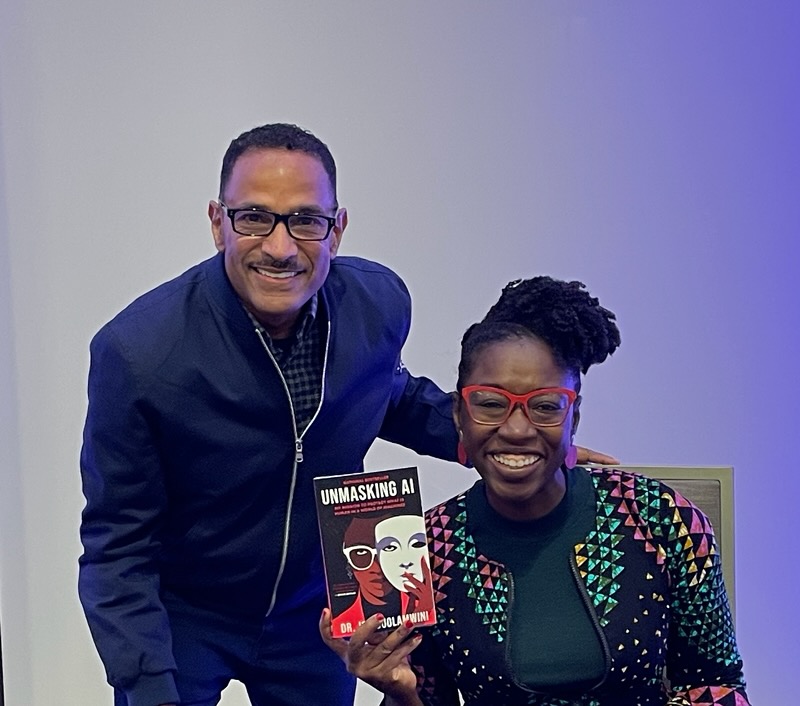
The rate at which Artificial Intelligence (AI) is growing is staggering. According to a 2023 MIT report, AI is transforming nearly every aspect of life from how we work and learn to how we communicate and solve problems while also contributing more than $2 trillion to the global economy annually. While the world races to adopt these tools, many in the Black community risk being left behind.

A 2021 Pew Research Center study found that only 58% of Black Americans had access to a desktop or laptop computer compared to 82% of White Americans. The digital divide, a historical barrier to educational and economic equity, is now becoming a chasm in the age of AI. Without proactive steps, the tools intended to advance society could deepen existing disparities. Efforts to introduce AI in everyday language and practice are critical to closing the gap and empowering historically marginalized communities to fully engage.
One way to do this is by helping people understand how AI shows up in our lives already. The technology is as close and far less complex than it may seem. From your phone’s autocorrect, your email’s spam filter, and even in your bank’s fraud alerts, AI is working with and for you. By demystifying how it functions, especially in familiar tasks, the barrier to entry is lowered. “People think AI is futuristic, but it’s already baked into our daily lives — from banking apps to smart TVs. The goal is to move from passive users to empowered creators,” stressed Stefan Youngblood, founder of Black AI Think Tank.
A basic starting point is to understand the difference between generative AI and predictive AI. Generative AI, like ChatGPT and DALL·E, creates content such as text, images, or code. Predictive AI powers tools that analyze past data to anticipate future outcomes — like recommendation engines or hiring algorithms. Once people grasp this distinction, the conversation becomes less about fear and more about possibility.

This possibility motivated Stefan Youngblood, founder of the Black AI Think Tank, to create a space for accessible learning. “We started with a simple question on Clubhouse: ‘What is ChatGPT?’” Youngblood explains. “Now we’ve built a movement to make AI feel accessible and necessary for the Black community.” The Clubhouse chat about AI basics in 2022 has grown into a 400-member community on LinkedIn focused on AI literacy.
During this year’s Black AI Literacy Week hosted by Black AI Think Tank, participants experienced five days of over two dozen speakers sharing how AI is changing the game and why the Black community must be actively engaged. The week exposed a larger truth that opting out is a detrimental choice when so much of the future is being written in code. Black AI Literacy Week stepped up to ensure that the Black community moves from participant to leader in the AI era.

The leadership space comes with challenges and concerns. Conversations within Black AI Think Tank often include questions about privacy, job displacement, and how to maintain control over personal information in an increasingly AI-driven world. Youngblood advocates for what he calls “digital hygiene,” helping community members understand how to protect their data while embracing innovation. He draws a parallel to the early days of computer adoption, pointing out that while automation did lead to job losses, it also created entirely new industries.
The work being done moves beyond simply technology; it is about building the confidence and infrastructure for Black communities to thrive in a digital future. As AI continues to evolve, so too must the presence and leadership within the Black community. AI, when wielded with equity and intention, can be more than just chatting, it can be a catalyst for real, lasting change.