
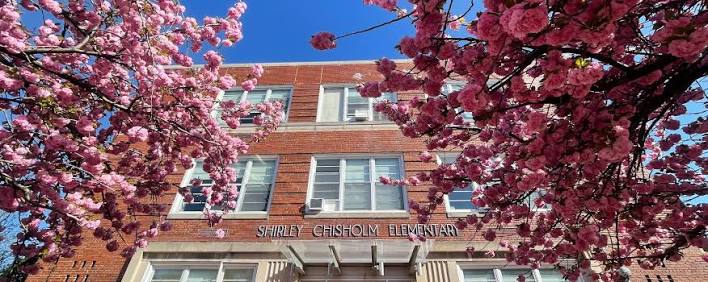

In May 2024, Ward 7 resident Kate Bockover’s two children missed several days of school after Shirley Chisholm Elementary School closed due to a gas leak. This is the reality for many students across the nation, as many buildings rely on outdated or inefficient temperature-regulation systems.
“It’s just a huge disruption to the school day, and it’s dangerous,” Bockover told The Informer. “It made me see how the system that we had was so unreliable… and it wasn’t a good way to heat and cool the school.”
As climate change continues to intensify weather extremes, making hot days hotter and cold days colder, more sustainable and environmentally resilient school infrastructure becomes more necessary than ever. Luckily, in Washington, a commitment to green policies and architecture makes the city a leading example of modernized educational infrastructure and what the future of building design should look like.
Shirley Chisholm Elementary School is undergoing a renovation of approximately 104,000 square feet that will include new playgrounds, parking and loading facilities, new fencing around the baseball field, and a solution to its previous gas pipe problem– a geothermal heat pump.
“D.C. has made investments in all-electric schools that demonstrate what electrification can look like in practice [and] these schools are using the latest electric technologies,” Cliff Majersik, senior advisor at the Institute for Market Transformation (IMT), told The Informer. “Heat pumps provide highly efficient heating and cooling in one system, eliminating the need for fossil fuel systems.”
John Lewis Elementary School (JLES), the first in the world to achieve both net-zero and platinum certification in LEED (Leadership in Energy and Environmental Design) and the WELL Building Standard, is a pioneer in the kind of transformation D.C. Public Schools (DCPS) is working to achieve. The school’s geothermal heating and cooling system, combined with its efficient design, reduced energy consumption by 9% and saved the District an estimated $250,000 annually in operating costs.

Others, like J.O. Wilson Elementary School, Harriet Tubman Elementary School and Benjamin Banneker High School, have also become examples of how city leaders, policymakers and designers should acknowledge the intersections between academic success, sustainable design and environmental stewardship.
A 2025 study from the Northwest Evaluation Association (NWEA) found that on hotter days, students are more likely to score lower on math tests, and since buildings are the largest contributor to greenhouse gas (GHG) emissions in the District, school buildings with green infrastructure serve as a double-edged solution.
“We want a system that is reliable and safe,” Bokover told The Informer. “As the climate is warming, we’re having more unpredictable weather, so I hope the heat pumps can… keep our kids comfortable while they’re learning.”
Sustainable Design, Policy: The Keys to a Greener Future
Geothermal heat pumps aren’t the only factor in electrifying and modernizing a school. For sustainability experts at Perkins Eastman, a global architecture firm, that renovation process includes preserving a building’s rich history and using materials and blueprints that elevate learning experiences.
The global practice champions the slogan “human by design,” which reminds architects at the company that they have a responsibility to design with the human experience in mind and ensure they’re having a positive impact on both people and the planet while looking for sustainable ways to take architecture to the next level.
“For us, designing a school goes way beyond just energy,” Juan Guarin, a Sustainability Specialist at Perkins Eastman, told The Informer. “Here in D.C., we have [the] slogan ‘net-positive education,’ and we build on the concept of zero energy to use that as an excuse to create high-performing learning environments.”
One way Guarin and his colleagues at Perkins Eastman do this is by limiting the window-to-wall ratio in school buildings and being conscious of glass usage. In cooler weather, heat is lost through windows, walls and floors. In warmer weather, a building heats up in the same way. By strategically placing windows, architects can reduce heat loss and gain and maintain regulated temperatures in schools year-round. While developing these designs, they also aim to achieve optimal daylight levels, as access to natural light can improve the learning environment.
These strategies improve how airtight a building is. The envelope at Banneker High School is so tight that there have been cold days when the heat pumps do not need to be turned on because minimal heat was lost inside classrooms. J.O. Wilson Elementary is another example of a building with an outstanding envelope.
“This is the most airtight building they’ve seen in the entire city,” Guarin told The Informer, “which is remarkable for an existing building that had such a huge amount of challenges [and] constraints from a historic preservation standpoint.”
Modernizing schools is improving students’ experiences and educational success. The Perkins Eastman team found that after the new building for the Paul Laurence Dunbar Senior High School was opened in 2013 with LEED Platinum certification, student test scores increased at a rate faster than any other school in the city. The high school has also produced more graduates since, with rates increasing from 60.3% before the new building to 83.4% in 2022.
“I like holding these buildings up as an example for schools across the nation… because it showcases that you can create high-performing buildings and you don’t have to compromise your purpose or main function,” Heather Jaregui, the director of sustainability at Perkins Eastman’s D.C. office, told The Informer. “You can create better learning environments… that support health and the wellness of students and their performance within those spaces… and meet your net-zero energy goals.”
Jaregui and Guarin worked on the modernization of Banneker High School, JLES, J.O. Wilson Elementary School, Harriet Tubman Elementary School, and more.
Such a large concentration of and prioritization for sustainable design like this wouldn’t be possible without the policy and legislation that enforce the need for these initiatives. Since Washington serves as a mirror for the rest of the country, its being a trailblazer in clean air and green infrastructure policy can bring forth motivation for environmental stewardship nationwide.
The District had the first Building Energy Performance Standard (BEPS), which was passed as part of the Clean Energy DC Omnibus Amendment Act of 2018, mandating energy efficiency in the city’s buildings to meet the Sustainable DC plan’s climate goal of reducing GHG emissions by 50% by 2032. Since then, 15 other cities and states across the country have adopted building performance standards.
With more sustainable modernization, a commitment to electrify transportation, and dedication to reducing air pollution, Washington saw a 42% decrease in GHG emissions in 2023 compared to its 2006 baseline.
“These policies are really moving the needle,” Majersik told The Informer. “They’re definitely moving us in the right direction, but we need to keep our foot on the accelerator if we’re going to achieve the ambitious climate commitments that we have.”
One of the keys to building a more environmentally friendly city is through passive design– a holistic architectural approach that takes every possible factor into account, including local climate, to design structures with exceptional envelopes and reduce and eliminate mechanical heating, cooling, ventilation and lighting demand.
Jaregui passionately champions passive design and believes it will help Washington and the rest of the world safeguard environmental and public health. She doesn’t agree with work that solely relies on mechanical systems and believes that prioritizing that reliance is a misstep in the architecture industry.
“At the end of the day, I don’t think that leads to a more resilient future, and I don’t think that’s how we’re going to get there,” Jaregui told The Informer. “What I would love to see more of is integrating smart passive design strategies into everything we do, and really highlighting the kind of reasoning behind that to the broader industry, so that that becomes the goal that we’re achieving.”
For parents like Bockover, the main priority is creating environments that will protect their children’s health and allow for future generations to live without disruptions exacerbated by systems that exacerbate climate change.
“You can see that gas systems are not the safest system available anymore,” the mother of two told The Informer. “Now, with the new upgraded systems, I think the air will be cleaner… and we won’t have that risk of missed school days because of gas leaks.”