
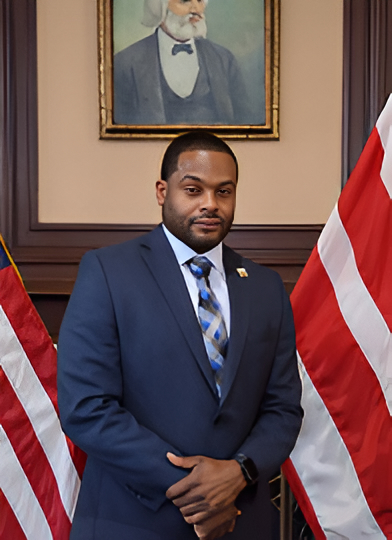
As District politicians and residents remember the life and legacy of Talib Shakir, a longtime community leader who died in an Oct. 9 e-scooter accident, they are also working to continue his commitment to providing pathways for all District residents to thrive.
“Through his work in public service, most recently leading the Mayor’s Office on Returning Citizen Affairs (MORCA), Talib was committed to creating opportunity for D.C. residents,” D.C. Mayor Muriel Bowser said in a statement. “In Talib’s own words, his mission at MORCA was clear: ensure returning citizens feel connected, valued, and included in D.C.’s future. We are so grateful for the energy and love he poured into doing just that for the city where he was born, raised, and served.”
Shakir, 50, spent more than two decades of his adulthood in prison after pleading guilty to fatally shooting a store clerk in 1993.
However, while incarcerated and after serving nearly 26 years, the native Washingtonian dedicated his career to uplifting his hometown and particularly a community for which he knew and cared about deeply: returning citizens.
“Talib made the most of his second chance and dedicated himself to helping others do the same,” Bowser continued. “He loved to mentor young people and to prove to them that their city believes in them.”
Activist and author Tony Lewis Jr. said he witnessed Shakir’s dedication to empowering others in action from the moment he met him.
The two first connected in 2016, when his father, Tony Lewis Sr., was a resident of the Federal Correctional Institute in Cumberland, Maryland. When Lewis was tasked with co-coordinating a public service announcement for the D.C. mayor’s office, offering advice to youth and young adults, he tapped his father and Shakir to serve as spokesmen.
“I interviewed my father, and I interviewed Talib — they both were inmates in federal prison at the time,” Lewis, author of “Slugg: A Boy’s Life in the Age of Mass Incarceration,” told The Informer. “The mayor’s office was able to cut that down into sort of a mini documentary or PSA, aimed at young people that were adjudicated and justice involved for the hopes of getting them to make different choices and not find themselves with these elongated sentences like my father and Talib had at the time.”
The video, Lewis said, was just one of many ways Shakir, a certified life coach, worked to mentor others while incarcerated.
“He and my dad also participated together in a program at Cumberland called YMI (Young Men Incorporated)… It was really about the older inmates, mentoring the younger inmates, particularly those that were serving long times, and were going to be returning to the community. They focused on education, and financial literacy and fatherhood, and things of that nature,” the activist continued. “He was definitely active inside, and so, when he came home, I think it was just natural for him to continue in that same vein.”
Exemplifying Possibility, Embracing Community
While Shakir spent more than 25 years in prison, he worked hard to make a difference in others’ lives throughout his 50 years on earth.
“His father was a very respected imam in the Muslim community, and so I think he got a chance to observe mentorship and community service. And he was a very, very intelligent guy,” Lewis, a native Washingtonian, told The Informer. “I think he had the passion to help those younger than him not make some of the mistakes that he had made.”
As Shakir poured back into the community through sharing life lessons, providing mentorship and creating opportunities, he also offered hope.
“I think that he exemplified what was possible. He wanted for returning citizens to be able to assimilate across the board, not just in certain industries or sectors. And I think he was an example of the brilliance that, in many cases, has been lost due to mass incarceration,” Lewis explained. “We’re grateful that he was able to return to the community and be that example for so many returning citizens in the city about what’s possible. He will be extremely missed.”
For Shakir, who was raised in Northwest, D.C., engaging with the community was critical in working to improve outcomes across the District.
“Talib championed a comprehensive approach to public safety and economic opportunity for D.C. residents,” D.C. Attorney General Brian Schwalb said in a statement. “He dedicated his career in public service to…. empowering D.C. residents to transform their lives.”
After starting his career as director of MORCA in December 2025, Shakir spent his day-to-day championing the rights and futures of returning citizens.

During April’s Second Chances Month, the director joined Washington Informer Publisher Denise Rolark Barnes to highlight a personal calling and year-round effort to ensure formerly incarcerated individuals in D.C. come home to opportunities that contribute to their integration back into society and overall transformation.
“It’s important for us to help them access jobs…housing and employment and to ensure that people have what they need to set themselves up for success,” Shakir said during an episode of “Let’s Talk,” The Informer’s digital program. “It’s a community, and it’s a community of people. And I think that we thrive well when we’re part of a community.”

Beyond returning citizens, the native Washingtonian and natural polyglot hoped for the best possible outcome for people across the nation’s capital.
“He contributed to all the residents of this city,” Lewis said.
‘D.C. Needs More Leaders Like Talib’
In the final months of his life, Shakir helped curate citywide events and backed initiatives to boost resources for returning citizens, including hosting job fairs and Welcome Home expos, assisting with vital record identification and credit score education, plus other ORCA in-reach services to meet people at their needs.
Among his proudest moments, he reflected on the Mayor’s Office’s recent successes reinstating programs and creating safe spaces and partnerships that allow formerly incarcerated individuals, and particularly women, to build community around shared truths and lived realities.
“It’s important for us to think about how women are reintegrated into society, [how] families are reconnected after incarceration. It’s important for us to focus on mental health access and making sure that that’s robust and that that is meaningful,” Shakir told The Informer in April. “So while there may be 65,000 [returning citizens in D.C.], we see at least between 5 to 7,000, and I think we’ve been pretty successful in reaching some of our goals and connecting people with the right resource…to become part of the community.”
Now, the community is working to remember the life of Shakir, who died in a two e-scooter collision on 8th Street and Pennsylvania Avenue SE on Friday night. Shakir was found unconscious at the scene and both people were taken to the hospital for treatment. The woman driving the other e-scooter survived her injuries and has been released from the hospital.
As leaders uplift Shakir’s legacy, they are also calling on others to further his work and commitment toward providing access to opportunities for all Washingtonians.
“We are forever grateful for his great contributions to our city,” Schwalb said. “D.C. needs more leaders like Talib.”
For Lewis, leaders and residents alike can further Shakir’s legacy by prioritizing the causes he championed throughout his life.
“I think it’s imperative that jobs, housing, and a lot of the other collateral consequences of incarceration be addressed, and I think that’s what he would have wanted, and I know that’s what he would have continued to fight for,” he told The Informer. “So that folks can live out their dreams and reach their full potential after they’ve been held to account for whatever mistakes they made in their past.”