
A White House proposal to prohibit federal grant money from being used for voter registration could directly affect Washington, particularly where federal dollars pay advocates to inspect voting centers, help people with disabilities exercise their voting rights, and intervene when physical or other barriers make casting a ballot more difficult.
The possible changes are especially significant in a city where Disability Rights DC has repeatedly found accessibility problems at voting locations and where its federally financed advocates have worked with election officials to correct some problems while voters were still arriving.
Disability Rights DC, a program of University Legal Services, operates the District’s federally funded Protection and Advocacy for Voting Access program. Federal records show University Legal Services received $141,043 for that work in fiscal 2026.
The organization has said the federal money is indispensable to its work.
“We could not do this work without our PAVA grant,” Disability Rights DC said on its website after describing its accessibility monitoring during the Ward 8 special election.
The Office of Management and Budget (OMB) is proposing changes to government-wide federal grant rules that would prohibit federal award money from being used for voter registration drives or “related activities,” according to a ProPublica investigation published Monday. The restriction would not take effect before the Nov. 3 midterm election.
Russell Vought, OMB director, has long opposed using federal money for voter-registration efforts. Neither Vought nor OMB responded to ProPublica’s questions about the proposed change. In a 2022 letter, Vought argued that a Biden administration executive order expanding opportunities for voter registration was a “power grab” that would increase registration and turnout, particularly among Democratic supporters.
The proposed rule could create an unusual conflict in Washington because Congress itself authorized federal money specifically to help people with disabilities register and vote.
The Help America Vote Act of 2002 established grants to help people with disabilities register, cast ballots, and gain access to polling places. Congress has provided about $10 million annually in recent years for 57 Protection and Advocacy organizations covering every state, Washington, D.C., Puerto Rico, Native American communities and U.S. territories.
In Washington, the federal program pays for work that has produced evidence of persistent accessibility problems.
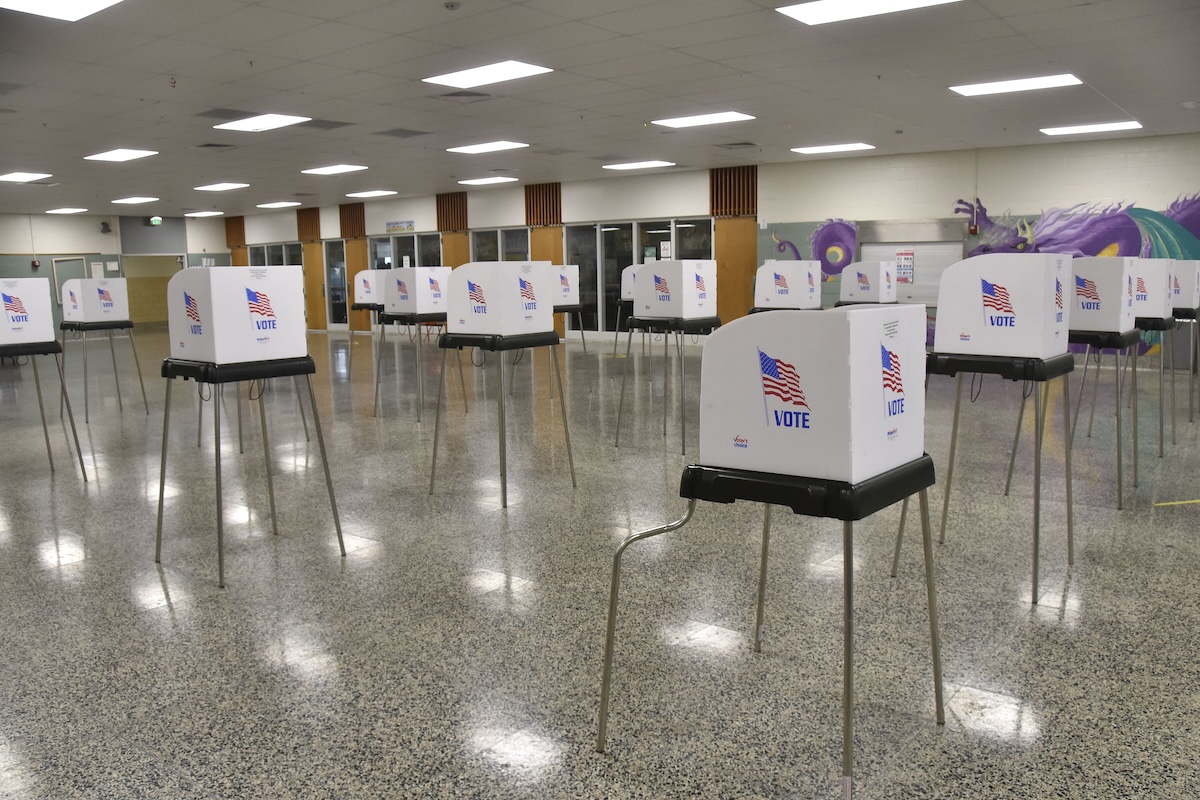
During the 2024 D.C. primary, Disability Rights DC surveyed all 75 vote centers and 55 ballot drop boxes and reported accessibility problems at 72% of the vote centers.
Two years earlier, the organization surveyed 87 of 90 voting centers during the 2022 general election and found accessibility problems at 64, or 71%. Problems included missing signs, inaccessible voting equipment, movable physical obstructions, broken elevators, and narrow doorways.
The work continued this year.
During the Ward 8 special election, Disability Rights DC visited 12 of 13 voting centers and made recommendations at some locations while voting was taking place. The organization said election workers implemented some recommendations immediately.
The D.C. Board of Elections has worked with Disability Rights DC and the D.C. Office of Disability Rights on accessibility surveys of voting locations, giving the federally supported program a role not simply in helping individual voters but in identifying problems across the District’s election system.

Those services potentially affect tens of thousands of Washington residents.
D.C. government data based on Census estimates found 10.9% of the District’s civilian noninstitutionalized population had a disability. The percentages were substantially higher east of the Anacostia River, reaching 15.9% in Ward 7 and 16.7% in Ward 8.
D.C. provides curbside voting, accessible touchscreen equipment at voting centers, and an Accessible Remote Ballot Marking System that allows voters with disabilities to mark ballots electronically using screen readers, tactile switches, voice recognition, and other assistive technology.
But equipment alone does not address every barrier.
Nationally, 3.6% of registered voters with disabilities reported having difficulty registering during the 2024 election, compared with 1.4% of voters without disabilities, according to Rutgers University survey data cited by ProPublica. Researchers estimated that the percentage represented about 740,000 registered voters with disabilities.
Rabia Belt, a Stanford University law professor who specializes in disability and citizenship, said she did not believe disenfranchising disabled voters was necessarily the rule’s intended purpose.
But she said, “It’s going to have that kind of effect.”
‘A Massive, Across-the-Board Power Grab’
The proposed restriction could extend beyond organizations dedicated specifically to disability rights.
Nonprofits receiving government money to help residents enroll in Medicaid, food assistance, and other programs covered by the National Voter Registration Act must provide voter-registration forms and help applicants complete them. ProPublica reported that organizations could therefore find themselves confronting one federal requirement telling them to provide voter-registration assistance and another restricting federal grant money from paying for it.
Other nonprofits receive federal grants for services unrelated to elections while using private donations for voter outreach. Experts said uncertainty over what constitutes a prohibited “related activity,” and the burden of proving that federal dollars were kept separate, could cause some organizations to curtail voter-registration work before the 2028 presidential election.
Legal challenges are expected if OMB adopts the rule.
Samuel Bagenstos, a University of Michigan law professor who served as OMB general counsel during the Biden administration, said the proposal raises a fundamental question about congressional authority because Congress decides how it appropriates federal money and has repeatedly funded disability voting programs.
“This is not even a surgical power grab,” Bagenstos determined. “It’s just a massive, across-the-board power grab.”
The administration has argued that its overhaul of federal grants is intended to increase oversight and ensure taxpayer money is spent only for authorized purposes. The proposed voting provision, however, would affect programs Congress expressly created to help people with disabilities register and vote.
Amy Miller, an attorney with Disability Rights Nebraska, described what that assistance can look like away from Washington.
Miller travels to nursing homes and assisted-living facilities and offers residents voter-registration forms while conducting other disability-rights work. She recently helped a veteran with a traumatic brain injury complete change-of-address paperwork so he could vote. At another facility, she encountered a man who had lived there for years but said no one had previously offered to guide him through registering.
Miller said she wishes the people writing voting rules could accompany her into those facilities and see residents discover that they can participate.
“I wish they could see that and realize how important the work is,” Miller said.