
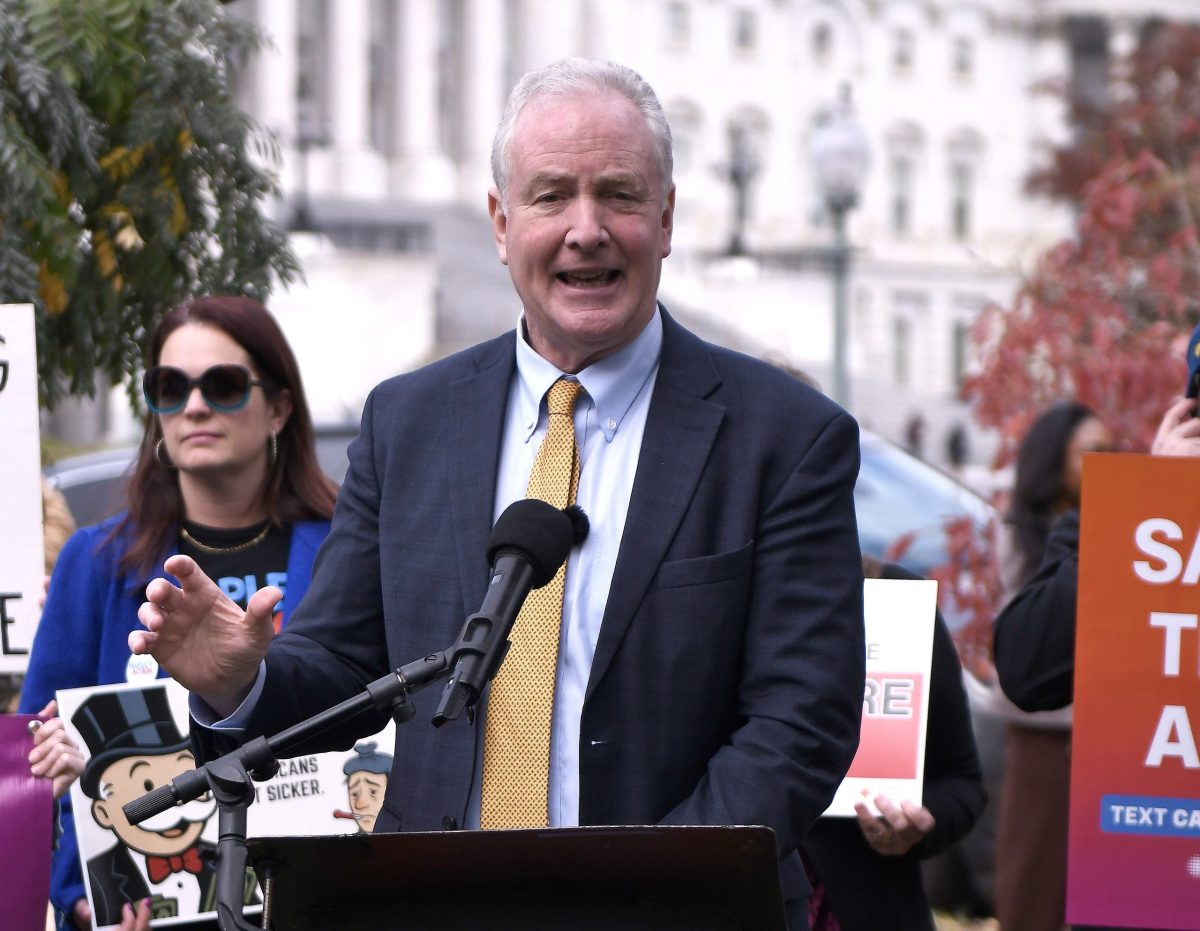

Nearly 2 million Americans have been looking for work for at least six months, and U.S. Sen. Chris Van Hollen (D-Md.) wants the federal government to help put them directly into jobs rather than leave them waiting for the labor market to take them back.
The Maryland Democrat has introduced the Ready to Work Act of 2026, legislation that would use federal money to help local workforce boards and community organizations create temporary paid positions designed to lead to permanent employment. The bill would also pay for training and services that address obstacles including child care, transportation and job readiness.
“Every American who wants to work should be able to find a job,” Van Hollen said. “But with AI as a looming threat to our workforce — and nearly two million Americans already unemployed for six months or longer — it’s clear that we need to do more.”
The Bureau of Labor Statistics reported that 1.93 million people had been unemployed for 27 weeks or longer in August, accounting for 27% of the nation’s unemployed. The average duration of unemployment had climbed to 26.3 weeks.
The legislation would establish the jobs initiative within the Department of Labor and operate it through local workforce development boards, which could partner with community-based organizations. Workers generally would have to be at least 18, legally authorized to work, out of work or school for at least 27 weeks and actively seeking employment for at least four weeks.
The jobs would not be unpaid placements or simply training programs, as participants would receive wages and benefits, with the federal government reimbursing participating employers for a share of those costs. Eligible employers could include government agencies, nonprofits, businesses and employment social enterprises.
The bill notes that workers could be placed in transitional jobs, apprenticeships or national service positions, with career services, training and other assistance intended to help them move into lasting employment.
The wage provisions set a floor because Van Hollen noted that participants could not be paid less than the applicable minimum wage or the amount needed for a family of four to remain above the federal poverty line. The bill’s section-by-section summary places the minimum salary at $15.87 an hour in 2026. Employers also would have to provide participants with wages, benefits and advancement opportunities comparable to those received by similarly situated employees doing the same work.
Federal reimbursement for wages and compensation generally could last up to 12 months and as long as 24 months for positions involving training that leads to a recognized credential. Employers would contribute toward the cost, with their share tied in part to local unemployment. In areas with unemployment of 5% or less, employers would pay 33% of eligible wage and compensation costs. That share would fall as local unemployment rises and could reach zero in areas with sufficiently high unemployment.
The bill includes restrictions intended to keep employers from replacing their existing workforce with federally subsidized workers. Participants could not be used to lay off or reduce the hours, wages or benefits of existing employees, take the work of striking employees or interfere with promotion opportunities.
Employers also generally could not fill more than 100 positions through the program or allow program workers to make up more than 10% of their workforce. Government agencies could not use the program to replace civil service positions.
Van Hollen’s legislation also makes artificial intelligence part of the government’s effort to understand why people are losing jobs and what they encounter while trying to find new ones.
Sens. Ron Wyden and Jeff Merkley of Oregon and Richard Blumenthal and Chris Murphy of Connecticut joined Van Hollen in introducing the legislation.
“With the looming threat of massive job losses from AI, we have to find new ways to protect Americans from long periods of unemployment and connect them to good-paying, stable jobs,” Murphy said.
Before applying for a program job, participants would report information about their most recent employment, why it ended and any AI used in that job. They also would report AI encountered during their job search, including its use in hiring, résumé screening or interviews.
The bill cites polling showing that 70% of Americans surveyed in March believed AI was likely to reduce the number of job opportunities, up from 56% in April 2025. It does not assume, however, that AI caused an individual worker’s unemployment. The reporting requirement would give the Labor Department information that could be used to track its role in employment and hiring.
“This bill reimagines and modernizes our unemployment system, creating a wider range of support resources, so that everyone looking for work can find work,” Murphy continued.
Areas with persistent poverty and low employment would be eligible for additional competitive grants. The bill defines a high-poverty area as one where the poverty rate has remained at least 20% for three years. Those grants could give local programs greater latitude to accept people who have been unemployed for shorter periods, extend subsidized employment, increase spending on training and support services or reduce employers’ required contribution.
The main jobs program would receive mandatory federal funding beginning in fiscal 2026. The legislation does not establish a fixed dollar amount, instead appropriating “such sums as may be necessary” for fiscal 2026 and subsequent years. The separate grants for high-poverty and chronically low-employment areas would depend on congressional appropriations beginning in fiscal 2027.
Workforce and community organizations such as the National Urban League, Service Employees International Union, National Association of Workforce Boards, Center for Employment Opportunities, Employ Prince George’s are supporting the proposed legislation.
For people who have already spent months submitting applications and waiting for an employer to say yes, supporters argue that the program would treat paid work itself as part of the route back into the labor force.
“Long-term unemployment doesn’t just scar the worker who loses income and skills — it destabilizes families and hollows out communities, and the market has proven it cannot fix this on its own,” said Mark Paul, an associate professor of economics at Rutgers University’s Bloustein School of Planning and Public Policy. “The Ready to Work Act steps in where the market has failed, guaranteeing real job opportunities for anyone locked out of the workforce.”