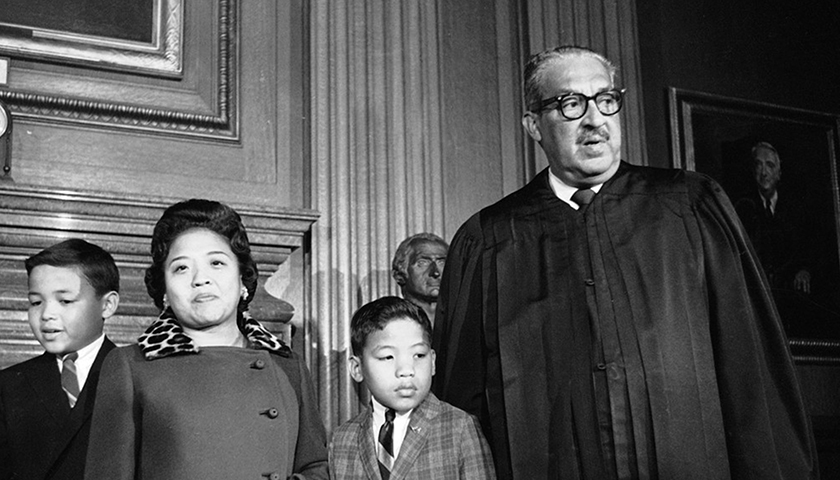

Oct. 2 marks a defining moment in American history. On that day in 1967, Thurgood Marshall was sworn in as the first Black justice on the United States Supreme Court.
President Lyndon B. Johnson’s appointment of Marshall was more than a historic milestone. It was a declaration that the American promise of equality must extend to the highest court in the land.
Marshall’s distinction was earned through a lifetime of extraordinary service. Born in Baltimore in 1908, he graduated first in his class from Howard University Law School in 1933. As chief counsel for the NAACP, he argued 32 cases before the Supreme Court, winning 29, including the landmark 1954 Brown v. Board of Education decision, which declared racial segregation in public schools unconstitutional.
Before joining the Supreme Court, Marshall served on the U.S. Court of Appeals and became the nation’s first Black solicitor general. He served on the high court for 24 years, retiring in 1991. His judicial career was defined by a commitment to civil rights, equal protection and the constitutional rights of vulnerable Americans.
Marshall’s appointment mattered because representation matters. For generations, Black Americans were excluded from the institutions that interpret the Constitution. His presence on the bench showed that barriers once considered permanent could be broken.
Yet his legacy invites difficult reflection. Clarence Thomas, appointed in 1991 to succeed Marshall, became only the second Black justice. Thomas’ conservative judicial philosophy has often put him at odds with civil rights positions associated with Marshall, particularly on affirmative action and voting rights. His rulings and public positions have drawn criticism from those who believe they weaken protections for Black Americans.
A justice is not required to share the views of others of the same race. But the contrast between Marshall’s civil rights legacy and Thomas’ jurisprudence marks an important chapter in the ongoing debate over equality under the law.
Hope for Black Americans returned to the Court in 2022 with the confirmation of Ketanji Brown Jackson, nominated by President Joe Biden, who became the first Black woman justice. Her historic appointment brings a perspective long absent from the bench and reminds America that progress, though incomplete, remains possible.
On this anniversary, we honor Marshall’s courage and service, recognize the ongoing debate over his successors, and celebrate Jackson’s presence as a reminder that the Supreme Court should reflect the nation it serves.
The work of justice remains unfinished. The promise of equal protection under the law demands that we keep moving forward.