After three days, a jury has yet to reach a verdict in the federal bribery trial of Ward 8 D.C. Council member Trayon White. Jurors even went as far as to tell U.S. District Judge Rudolph Contreras on Friday that they were deadlocked in their decision.
For at least one D.C. resident, such a development sparks hope for a positive outcome.
“Trayon will be declared innocent,” said Ward 7 resident and community advocate Leniqua’dominique Jenkins. “[Before the trial], people had opinions about the evidence … but actually sitting through the case … a lot of information that wasn’t provided really caused people to be like, ‘wow.’ It made them process differently and look closely in terms of Trayon White being innocent.”
On Sept. 22, Jenkins counted among the dozens of residents, jurists, and reporters who filled the gallery of Courtroom 23 in E. Barrett Prettyman U.S. Courthouse in Northwest as the prosecution and defense cued up their closing arguments in White’s federal bribery trial. Throughout much of the trial, Jenkins followed media reports and spoke with neighbors about key findings from each side, including the FBI recordings of White’s interaction with confidential human source Allieu Kamara, and government witness testimony countering the prosecution’s assertion that White overtly demanded an extension of a contract for Kamara’s business, Life Deeds.
Jenkins, a sister and daughter of returning citizens, and an author who’s hosted book clubs in federal prisons, told The Informer that sitting in the courtroom and hearing what both sides presented allowed for a more well-rounded opinion.
“Folks that haven’t been in the courtroom to hear both sides of the story have been missing facts and evidence,” Jenkins said. “A lot of information that’s online has been redacted [and] manufactured in a way that contradicts innocence. Sitting in the courtroom, you see the totality of the information. You get the full breadth of the data [that’s] not manipulated in a way to lean left or right.”
Looking at the case through a racial and socioeconomic lens, Jenkins expressed solidarity with Black working-class District residents who, as she recounted, faced online vitriol for taking time off from their jobs to sit in on the trial. As she too listened in on the trial, Jenkins pointed out what she called an extra layer of context that the defense should’ve presented.
“I wish there woulda been a sociolinguist to unpack the urban vernacular that would’ve given folks in the jury more background and understanding about language, how it varies across communities and age groups,” Jenkins told The Informer. “When I listened to the tape, it was clear it wasn’t a bribe. The intent to act on a bribe wasn’t there. If those experts would’ve been present, that would’ve been an abundance of proof. Those information gaps would’ve been closed.”
A Difficult Statute, and a Council Member’s Gratitude
Upon the jury’s announcement of a deadlock on Sept. 25, White’s lawyers called for a mistrial while the prosecution objected. Contreras deferred to the prosecution, telling jurors to mull some more over the facts of the case and the instructions given to them.
“I know it’s a difficult statute,” Contreras told jurors, in reference to U.S.C. § 201, which concerns bribery.
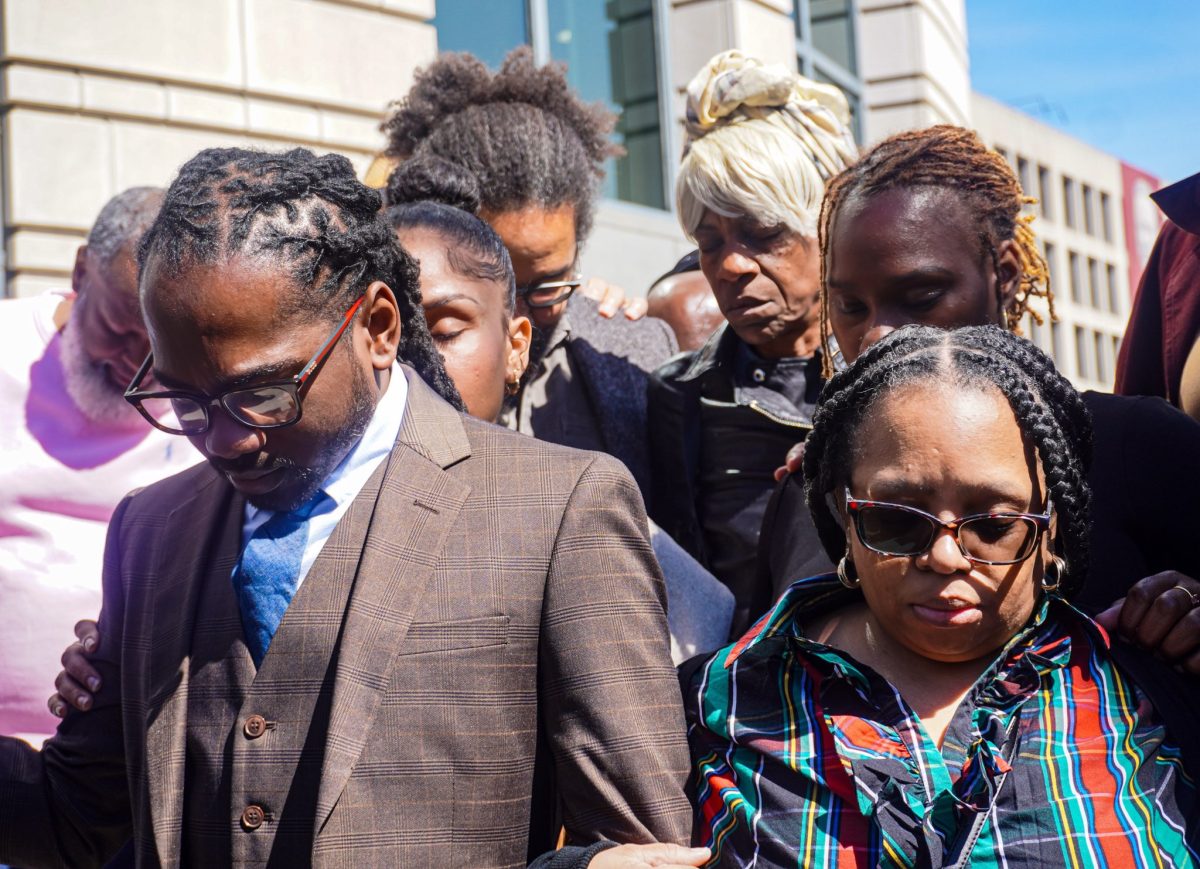
Hours later, near the corner of 3rd Street NW and Constitution Avenue NW, White expressed gratitude for the support he’s received throughout the duration of the trial.

“I’ve seen a lot of people in my situation that never left these doors,” said White, flanked by dozens of people who’ve shown up to the court proceedings over the last two weeks. “I had to [write] reference letters or show up to be a character witness for somebody, and they had no support. The amount of love and support I’ve received from this region has been second to none. I’m forever indebted, and I’m forever grateful.”
White also reflected on the road ahead.
“We have not [gotten] a decision about the jury today, unfortunately or fortunately,” White said, “but even then we’re still patient. We’re still believing, and we’re still pressing. I want to thank Gary Kohlman and my legal team…for their hard work and dedication in getting us thus far, but we’re not there just yet.”
Days earlier, on Sept. 22, the prosecution and defense made their closing arguments, with the former focusing exclusively on the FBI recordings between White and Kamara, identified by the defense as White’s brother-in-law. By then, White had already attended a ribbon-cutting for the newly modernized Malcolm X Elementary School and virtually weighed in on policy during a D.C. Council breakfast meeting preceding the council’s first legislative meeting of the fall season.
In her closing arguments, however, Assistant U.S. Attorney Rebecca Ross focused not on what the defense called White’s love for community, but the content of the FBI recordings.
“Over and over again, you saw [him] stuffing envelopes of cash and agreeing to get to work,” Ross said. “You also know why … greed and personal debt …. Having girls and having fun was expensive … the language was explicit … outlined in this bribery contract.”
Ross went on to demand that the jury pay no mind to Kamara’s involvement with federal law enforcement while she zeroed in on what she described as White’s consent to participate in bribery.
“It doesn’t matter that Mr. Kamara was working for the FBI,” she said. “Whether or not you approve the use of a confidential human source…one factor is the agreement is the bribe… there is no doubt what that money is for.”

For the better part of the week, a jury that’s now, with the removal of a woman and Black man as alternates, winnowed down to 12 discussed the details of the federal bribery case. On Sept. 23, jurors asked whether the definition of bribery, as outlined by the court, involves them seeing any benefit of Kamara’s business receiving a contractual extension.
Other questions centered on whether the receipt of gifts, as outlined in the D.C. Code of Conduct, constitutes a violation of official duty. Jurors also asked if bribery could be considered as such if the defendant never followed through with the request. Both sides, once again, also zeroed in on the elements of 18 U.S.C. § 201 that define bribery, two of which are: a public official, elected representative, government employee, or someone acting on behalf of the government being the recipient of the alleged bribe; and the person paying the alleged bribe directly or indirectly giving, offering or promising a benefit.
The third, and most contentious, element at the center of jury deliberations concerns “corrupt intent,” or a mutual understanding that connects the gift to the alleged bribe recipient’s violation of their official duty. In his closing statements days earlier, White’s attorney Warren G. Kohlman told jurors that the prosecution’s evidence doesn’t speak to White’s intent.
“Mr. White is not corrupt,” Kohlman said in his closing argument. “I told and predicted that the government doesn’t get it. Not one witness has talked to you about a corrupt act. The issue is what was Mr. White’s state of mind during the conversations.”
Kohlman later pointed out that statements given by government witnesses not only corroborates White’s innocence, but calls into question the validity of information Kamara provided to initiate the FBI sting against the Ward 8 council member.
“[Former D.C. grants supervisor] Anwar Walker … was not with Trayon.. Karl Racine never met with Trayon,” Kohlman said. “All the discussion going on here amounted to Trayon White doing nothing. He had no intent other than to look at the contract. There is absolutely nothing on the record in front of you that establishes he did anything.”
Before wrapping up his statement, Kohlman spoke to the Ward 8 council member’s character versus that of Kamara, saying that character witnesses, former Ward 8 D.C. Council office chief of staff Wanda Lockridge and D.C. Public Schools and Harvard University alumnus RuQuan Brown, affirmed White’s contributions to the community while on the stand.
When it came to Kamara, however, Kohlman didn’t mince words.
“Do not underestimate Kamara,” Kohlman told jurors.
The Bigger Picture, According to a Supporter of White
For activist-entrepreneur Jauhar Abraham, the prosecution intentionally distorted Kamara and White’s relationship to circumvent a tenet of the D.C. Council Code of Conduct, approved during Council Period 25 (2023-2024), that allows the acceptance of gifts “under circumstances that make it clear that the gift is motivated by a family relationship or personal friendship rather than the position of the employee.”
“If you knew the D.C. Code that the council set, you could get unlimited gifts, contributions or money from the family member,” Abraham told The Informer, “but if it’s just a local businessman, the way they presented it, then it would appear that that would have the appearance of criminal conduct.”
Abraham counted among those who sat in the court gallery throughout the trial as witnesses called by the prosecution — former D.C. grants supervisor Anwar Walker, D.C. Deputy Mayor of Public Safety and Justice Lindsey Appiah, and Office of Neighborhood Safety and Engagement Director Kwelli Sneed — admitted on the stand that White never explicitly pushed them to extend Life Deeds’ contracts.
That alone, Abraham said, exonerates White.
“Their case was centered around three government witnesses that would come and tell you that Trayon White pressured them, intimidated them, or asked them to give Life Deeds a contract,” Abraham told The Informer. “Kwelli Sneed said it never happened. Mr. [Anwar] Walker said it never happened. Deputy Mayor Lindsey Appiah said it never happened, so they essentially became witnesses for him.”
Abraham, like others rallying around White, expressed concern about Kamara and how he remained a free man, even after admitting to paycheck protection program [PPP] fraud. As revealed in court proceedings, Kamara kept the millions of funds illegally amassed and launched a nonprofit known as District Services Manager, which his wife, Kelly Winston, sat at the helm of as executive director.
All of that, Abraham told The Informer, highlights the federal government’s fear of White more than anything.
“I see the FBI bring a guy in my community who essentially was running a continued criminal enterprise, and they only want his communication with Trayon White and they know that this guy’s committing all kinds of fraud and crimes but they don’t ask for tax returns,” Abraham told The Informer. “They don’t ask for his assets. What is the price on Councilmember White’s head? If he had been involved in bribing him, why didn’t they ask [Kamara if he] help[ed] him get any of the contracts that he got prior to 2019? All this stuff came up after he was arrested for the PPP stuff, and you saw what he’s up against.”