
Last Updated on June 9, 2025 by BVN
Kenneth B. Morris, Jr.

Whenever I speak to students or even adults, I like to ask a simple question: “Who was the first African American to be honored with a public statue in the United States?” The most common guess is Dr. Martin Luther King Jr. or Rosa Parks. Once, a woman confidently answered Abraham Lincoln, which made me wonder if she had missed part of the question.
But the answer surprises almost everyone.
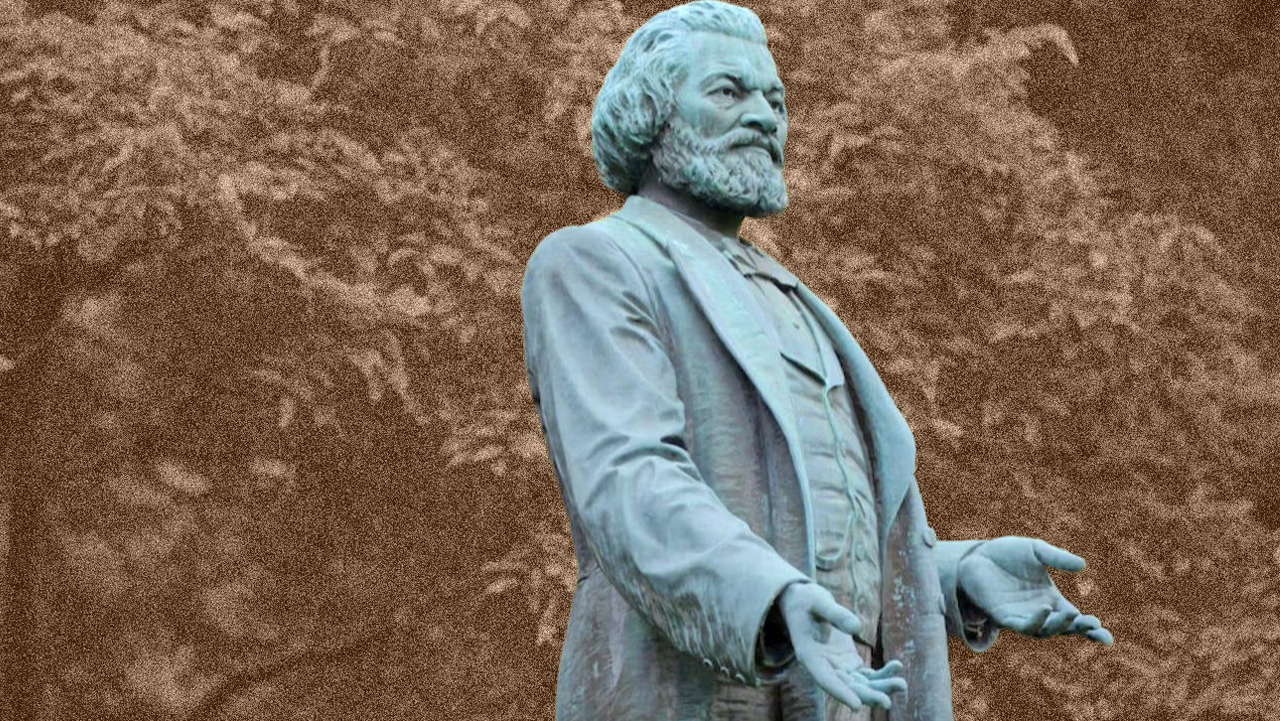
On June 9, 1899, a remarkable event took place in Rochester, New York. A statue was unveiled that made history, not just locally but nationally. It was the first public statue in the United States ever dedicated to an African American. That statue honored my great-great-great-grandfather, Frederick Douglass, and was erected just four years after his death in 1895.

The effort to create the monument was led by Dr. Walter Cooper Thompson, a respected Black educator and civic leader in Rochester. He believed that Douglass’s contributions to freedom and justice should not fade into memory but be etched into the public consciousness. In an era of racial violence and legal segregation, Thompson saw the statue as a bold affirmation of Black humanity, resolve, and rightful place in the American story.
The choice to commemorate Frederick Douglass in bronze at the turn of the 20th century was nothing short of groundbreaking. At a time when no public monument in the United States had ever been dedicated to an African American, this statue stood entirely alone. It was the first of its kind, a public acknowledgment of Black leadership, dignity, and contributions in a nation that had yet to fully recognize those truths—in honoring my ancestor, the people of Rochester made a bold and visionary statement about who deserved to be remembered and why.
The statue’s original location was equally bold: it stood directly in front of Rochester’s train station. The city’s mayor at the time, George E. Warner, wanted every visitor who arrived or departed to know that this was a city defined not by conquest or commerce but by conscience. Mayor Warner wanted each visitor to know precisely who this city claimed as its most outstanding citizen. That bronze figure stood as a declaration that my great ancestor’s voice, his vision, and his truth were not only welcome here, but they were central to the city’s identity.

Over the years, the statue has moved across the city, echoing Douglass’s enduring presence in Rochester. In 1941, it was relocated from the train station to Highland Park Bowl, a more secluded and serene space. But as years went by, its placement there limited public visibility. In 2019, the statue found a new and prominent home at the Frederick Douglass Memorial Plaza at the corner of South Avenue and Robinson Drive—restoring its role as a visible and vital landmark in the city he helped shape. And now, thanks to the innovation of lighting, you can spot the great abolitionist after dark!
There is personal history in that monument for me as well. The sculptor, Sidney W. Edwards, needed a model for the body of the statue, and it was my great-great-grandfather, Charles Douglass, Frederick’s youngest son, who stood for him. For the face, Edwards used Frederick Douglass’s actual death mask, giving the artwork a haunting and powerful resemblance to the man himself. In a real sense, our family is embedded into that sculpture—body and face. And over the years, the statue has moved across the city, echoing Frederick’s restless journey for justice, always upright, always pointing north.

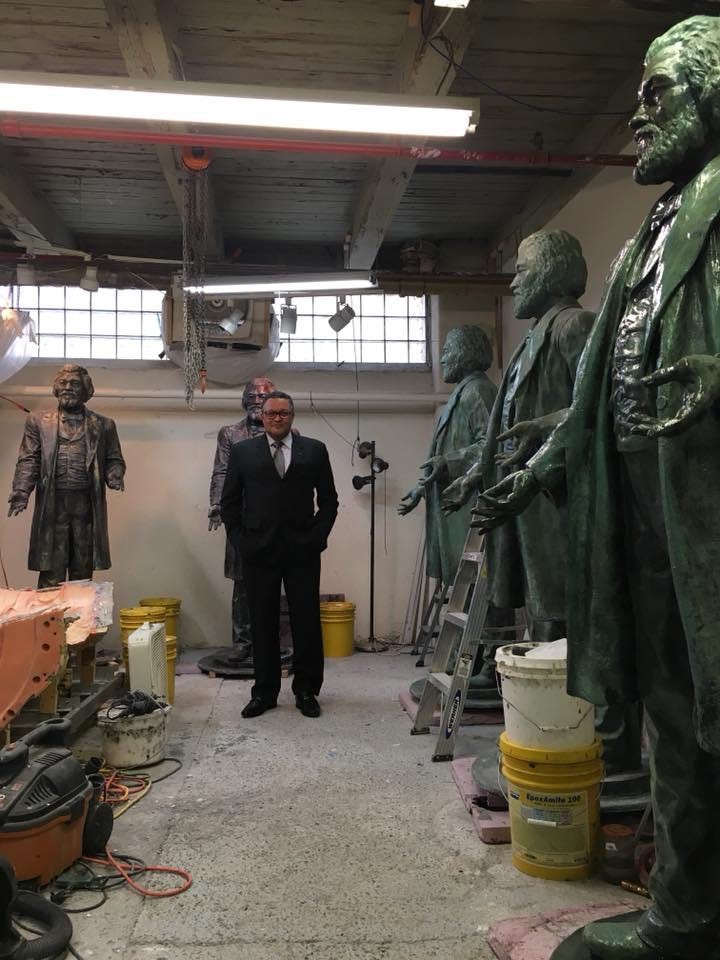
Fast forward to 2018, the bicentennial of Frederick Douglass’s birth. The city honored his legacy again, this time not with one statue but with thirteen new ones. These resin statues were intended as temporary installations, planned to remain in place for about three years, but they stayed up for nearly six years—a testament to their lasting impact. Placed in locations significant to his life in Rochester, including Corinthian Hall, where he delivered his famous Fourth of July oration; Mount Hope Cemetery, where he and his wife, Anna, and their two daughters are buried; and other sites that formed the fabric of his everyday life, they offered the community a way to walk with history.
And in a gesture that still gives me chills, sculptor Olivia Kim cast my hands for the statue’s hands, connecting me to Charles Douglass, who posed for the body of the original monument, and through him, to Frederick. Now, when young people place their hands on the hands of these monuments, they’re reaching across time to a lineage of struggle, strength, and hope.
It was an emotional experience. As I placed my hands in the molding clay, I thought about the lineage I carry. I thought about Frederick’s hands, once bound by slavery, later raised in defiance, ultimately lifted in unity. And I thought about how symbolic it was to carry that history forward through the next generation, through my own hands.

But the true power of the bicentennial project came from the community. Students, artists, activists, and residents engaged with these new statues in ways I never anticipated. They didn’t just walk past them. They stopped, reflected, discussed, and, in some cases, even wept. For many students, it was the first time they’d seen history meet them where they lived. Those statues didn’t just honor the past. They activated the present.
One of the most beautiful traditions around the thirteen bicentennial statues is the way the people of Rochester, especially children, cared for them. In harsh winters, you would find Frederick wrapped in scarves, gloves, or knit hats: small, playful acts of affection that turn a winter chill into a moment of care. These simple expressions speak volumes about how deeply Rochester embraces the man and his message.

This year, as in past years, I had the honor of preparing remarks for the annual commemoration of the statue’s unveiling on June 9. I’ve never been able to deliver them in person because I’ve been leading our Footsteps to Freedom Underground Railroad study tours during this time each year. Although I couldn’t be there in person, I was grateful to have my friend, David Shakes, deliver the remarks on my behalf. You can read the full text of those remarks at the end of this article.

As we commemorate this anniversary and stand once again in the shadow of the nation’s first statue of an African American, let us understand the magnitude of what that statue meant and still means. It is not just a monument to a man. It is a call to action. A reminder that justice is not inevitable. It is made, shaped, and sustained by those who choose to remember and those who choose to act.
This legacy is not just mine to carry. It belongs to all of us.
In freedom,
Ken
[Click here to read my June 9, 2025, statue commemoration remarks]